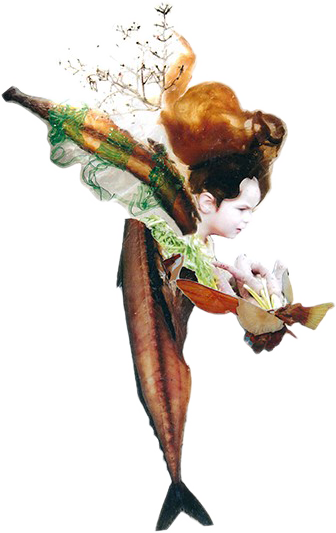
Nonsense make sense when you’re hungry
Nonsense make sense when you’re hungry (2023 - 2025) texturises a glitch in food to explore communication and interaction between humans and non-humans. Knitting is the main method, with mathematical theorems as a guide.
The work combines edible materials, such as vegetables from a London farmers’ market, with industrial surplus, vintage items and leftovers found on the street.
It began with an anecdote about leftover bread. Risa photographed leftovers she found on the street and shared them on Instagram, where the posts attracted spam comments. Taking the idea of spam, she knitted a “SPAM” food and offered it back to people to observe their responses.
The maths draws on graph theory, using tree structures, and on quaternions. Quaternions shape the three-dimensional forms, while trees visualise the cycles of the leftover data.
The intention of this project is to make and see everyday life focused particularly and consciously as there is so much information around people’s live and not always easy to focus on the details.
Final outcome
Practical system of work
“A Tin of Leftovers” you are going to eat and digest with an instruction to navigate your nourishment: introduce the research; the leftovers into your bodies. I believe this project is addressing to reconsider the way of living and communication with the environment that surrounding people.
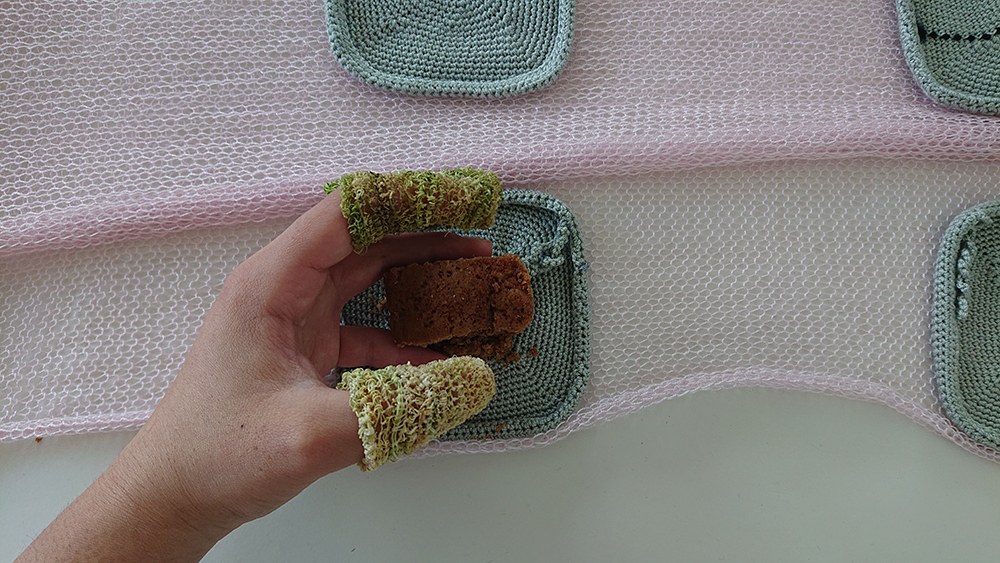
This work is experimentally and participatory happened on the different occasion and participants. “A Tin of Leftover”; the leftover from collecting food anecdotes; food waste to serving transformation of data collection is baked with celery without fibres; the idea of spam. Participants eat with fingers without the fingers which is wearing the finger hats made celery and rhubarb. This suggests the finger hat (textile represents the spiral: spam) cannot attach the celery loaf when the participants eat, that represent the visualisation of leftover food on the street on Instagram feed. Thus, the participants can experience the communication and interaction of leftovers and public/people/myself through this eating.
Finger & palm hats for eating
These finger & palm hats perform as the visualisation of communicating the leftovers data collection in the participation. The participants wear them when they eat. These finger & palm hats are crocheted with celery and rhubarb from London farmers market.
These crochet finger & palm hats are made of celery and rhubarb from London farmers market with *beetroot jerry +green pepper + salt. *beet root is also from London farmers Market
These crochet finger & palm hats are made of celery and rhubarb from London farmers market with *beetroot jerry +green pepper + salt and leftover rayon floss(second). *beet root is also from London farmers Market
A Tin of Leftovers
A Tin of Leftovers is baked with celery from London farmers market infused the leftovers information in the participatory performance.
Nonsense make sense when you’re hungry - A Tin of Leftovers (participatory performance)
Nonsense make sense when you’re hungry - A Tin of Leftovers (participatory performance)
The leftover from the participant
Eating sample
Nonsense make sense when you’re hungry - A Tin of Leftovers (participatory performance)
After eating
Research and process
Nonsense make sense when you’re hungry (Vol.0: anecdotes collection)
Primary research
Nonsense make sense when you’re hungry - A Tin of Leftovers (participatory performance)
After eating
@ediblecat.leftover (Instagram)
Research for how, who, what and why leftover, particularly food. (public engagement with Instagram) How I get spam, SPAM, Spam.... Most of feeds are getting spam responses.
PLEASE VISIT: @ediblecat.leftover
Spam with Maille sauce
Research experiment: taking out the leftover (Instagram) communication/interaction into physical: tactile environment.
Research development
Spam with Maille embodyment/Illustration: visualisation of the data, interacting between the leftovers and human/other than human(spam) used by mathematics; Tree (graph theory) and Quaternion.
Development
Edible crochet with mushroom, celery, fennel and rhubarb from London farmers market.